
BSC6680

El BSC6680 implementa las funciones de un controlador de estación base (BSC) y la función de control de paquetes (PCF) en los sistemas CDMA2000 1X y CDMA2000 1xEV-DO (en lo sucesivo, 1X y EV-DO, respectivamente).
The BSC6680 implements the functions of a base station controller (BSC) and packet control function (PCF) in the CDMA2000 1X and CDMA2000 1xEV-DO systems (hereinafter referred to as 1X and EV-DO, respectively).
The BSC provides the following functions:
- Controlling and managing base transceiver stations (BTSs)
- Establishing and releasing call connections
- Providing reliable wireless connections for upper-layer services through soft and hard handoffs
- Implementing power control
- Managing radio resources
The PCF provides the following functions:
- Managing radio-packet (R-P) interface connections
- Processing PCF signaling
- Maintaining Point-to-Point Protocol (PPP) connections
The rapid development of mobile telecommunication technologies accelerates product evolution. This factor, together with increasing operational expenditure (OPEX) and intensifying competition, increases investment risks and reduces the profit margin of operating a CDMA network. Thus, operators must consider how to reduce investment risks and maximize investment returns.
The BSC6680, maintaining the concept of "continuous client-oriented innovation", adopts industry-leading hardware and software architecture, and features large capacity, high integration, excellent performance, low power consumption, and easy maintenance. In addition, the BSC6680 supports 1X, EV-DO, and IP transmission, and enables smooth network evolution into the long term evolution (LTE) network system. By providing the BSC6680, Huawei assists CDMA network operators in building excellent mobile networks with the theme of "Convergence, Broadband, Green, and Evolution."
As data services develop, the demands for high-speed data services increase as well. The BSC6680, based on all-IP switching technology, can meet the increasing demands for high-speed data services without affecting voice quality and system stability.
The BSC6680 supports EV-DO Rev. B, a wireless broadband solution evolved from EV-DO Rev. A. Currently, EV-DO Rev.B is at phase I. By binding multiple EV-DO Rev. A carriers together, EV-DO Rev. B Phase I significantly improves data transmission rates and the subscriber experience. Implemented on the CSM6800 channel board through a software upgrade, EV-DO Rev. B Phase I significantly increases network performance, maximizes return on investment (ROI), and facilitates network deployment at low costs.
- A maximum of three forward or reverse carriers can be bound together. The downlink peak rate reaches 9.3 Mbit/s, and the uplink peak rate reaches 5.4 Mbit/s.
- Seamless network handoffs can be performed between single-carrier areas and multi-carrier areas.
- EV-DO Rev. A and EV-DO Rel. 0 are supported. In addition, EV-DO Rev. B Phase I is supported only after the BSC software and the BTS software are upgraded.
- Idle handoffs and active handoffs between an EV-DO Rev. B network and an EV-DO Rev. A/EV-DO Rel. 0 network are supported.
- Dormant handoffs between an EV-DO Rev. B network and a 1X network are supported.
According to actual network deployment requirements, the BSC6680 can be used to deploy a 1X network or an EV-DO network. In addition, the BSC6680 supports CDMA digital trunking communication marked by push to talk (PTT).
1X Networking
Figure 1-1 shows the networking of the BSC6680 in a 1X network.

Networking of the BSC6680 in a 1X network
| BTS: Base Transceiver Station MSCe: Mobile Switching Center Emulation HLR: Home Location Register AAA: Authentication, Authorization, and Accounting SMC: Short Message Center ISDN: Integrated Services Digital Network PSTN: Public Switched Telephone Network |
BSC: Base Station Controller MGW: Media Gateway AC: Authentication Center FA: Foreign Agent PDSN: Packet Data Serving Node PLMN: Public Land Mobile Network |
MSC: Mobile Switching Center VLR: Visitor Location Register GMSC: Gateway Mobile Switching Center SCP: Service Control Point HA: Home Agent M2000: iManager M2000 Mobile Element Management System |
EV-DO Networking
Figure 1-2 shows the networking of the BSC6680 in an EV-DO network.

Networking of the BSC6680 in an EV-DO network
AN AAA: Access Network Authentication, Authorization, and Accounting
Digital Trunking Networking
Figure 1-3 shows the networking of the BSC6680 in a digital trunking network.

Networking of the BSC6680 in a digital trunking network
| TSC: Trunking Switching Center CBS: Combined Billing Solution VPN: Virtual Private Network SMT: Service Maintenance Terminal |
GLMS: Group and List Management Server IPCC: IP Call Center KDC: Key Dispatch Center |
iGWB: iGateway Bill DPA: Attendant Position Agent DPT: Dispatcher Terminal |

The iGateway Bill (iGWB) and the combined billing solution (CBS) can be used in the digital trunking network. Any of the preceding billing solutions can be configured according to actual networking requirements.
Cabinet
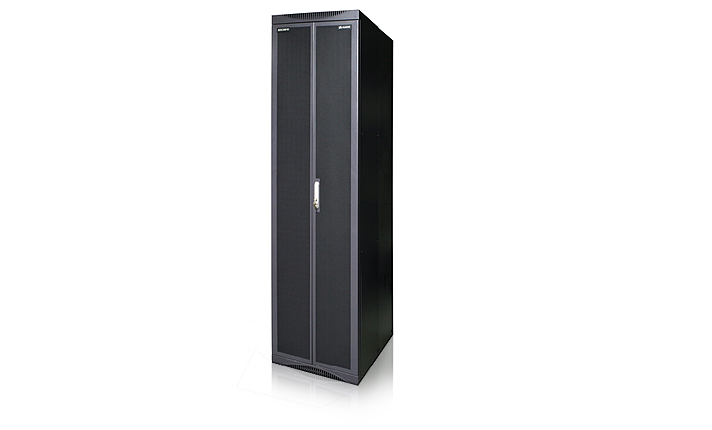
The BSC6680 adopts Huawei N68E-22 cabinet, with the design in compliance with IEC60297 and IEEE standards. Figure 1-4 shows the exterior of the N68E-22 cabinet.

Exterior of the N68E-22 cabinet
Adopting industry-leading technologies, the BSC6680 provides a large-capacity all-IP platform and a remarkably reliable design, thus assisting network operators in building green, future-oriented communications networks.
All-IP Switching Technology Facilitating Network Deployment and Supporting Network Evolution
Adopting the all-IP switching technology, the BSC6680 provides high IP transmission efficiency and various transmission modes such as E1/T1, FE/GE, and STM-1/OC-3. This facilitates network deployment in urban areas, remote islands, and deserts. In addition, the all-IP switching technology requires less NEs, thereby simplifying system design and improving system integrity, thus improving system performance and facilitating network deployment.
Based on the dual-plane, all-IP switching architecture of the BSC6680, the switching capacity of one service subrack is 120 Gbit/s, and the processing capacity of one backplane is 640 Gbit/s. Thus, the BSC6680 can meet the requirements for capacity expansion. In addition, the switching capacity of one service subrack can be expanded to 1000 Gbit/s to meet the requirements for wireless network evolution, thus protecting customer investments. The bandwidth of one service board ranges from 2 Gbit/s to 4 Gbit/s; the inter-subrack bandwidth ranges from 4 Gbit/s to 24 Gbit/s. The distinctive and uniform all-IP switching guarantees the quality of service (QoS) and supports the future-oriented evolution of mobile networks.
The BSC6680 supports the 2.1 GHz band and a dual-band networking solution. In the dual-band networking solution, the 2.1 GHz band and the 800 MHz band can be used in the same sector, thus maximizing the utilization of network resources and reducing networking costs.
Improved Voice and Data Services for a Better Subscriber Experience
The BSC6680 improves subscriber experience in voice and data services, continuously optimizing network performance and transmission networking, and thus enhancing serviceability. By using the voice quality evaluation (VQE) technology, the BSC6680 improves voice quality as perceived by subscribers. In addition, the BSC6680 provides an end-to-end (E2E) function for monitoring voice quality, thus improving the efficiency of network optimization.
The BSC6680 supports Fourth Generation Vocoder (4GV) coding and decoding algorithms when the A interface uses time division multiplexing (TDM) networking. Using multiple audio codecs, the 4GV allows network operators to balance voice quality and network capacity. The balance between voice quality and network capacity is implemented by adjusting the capacity operating point (COP) value. The higher the COP value, the larger the network capacity; the lower the COP value, the better the voice quality.
In addition, the BSC6680 adopts the EVRC2.0 algorithm when the A interface uses TDM networking. In the EVRC2.0 algorithm, the EVRC coding model is optimized, and thus voice quality is improved.
The BSC6680 can compensate for lost packets in the parameter domain. In the case of error frames, this function efficiently improves voice quality. When the reverse frame error rate (FER) is lower than 5%, the perceptual evaluation of speech quality (PESQ) is higher than 3.2. When the reverse FER is lower than 3%, the PESQ is higher than 3.5.
In addition, the BSC6680 controls echo when the A interface uses IP networking. This function efficiently improves subscriber-perceived voice quality, thus improving subscriber experience.
The BSC6680 optimizes the function of tracing internal signaling and provides the function of capturing service packets and collecting the statistics on service packets during the whole service process. Thus, signaling problems and service problems can be quickly located. This guarantees the location of data service faults.
The experience of different subscribers in EV-DO services varies. By using an E2E service experience improvement solution, the BSC6680 improves the priorities of light-traffic subscribers so that they can browse Web pages smoothly. In addition, the BSC6680 improves the stability of data downloading during intra-AN hard handoffs and inter-AN handoffs and thus guarantees the stability of service rates. The BSC6680 supports EV-DO Rev. A. After the BSC software is upgraded, the BSC6680 supports EV-DO Rev. B and thus supports a higher peak rate and higher throughput. In summary, the BSC6680 makes operators more competitive by providing customized solutions for guaranteeing the quality of data services.
A Unified Platform for Remarkable Compatibility
The Platform of Advanced Radio Controller (PARC) platform, the most advanced platform developed by Huawei, is applied to CDMA, GSM, and UMTS networks. Using established technologies, the PARC platform supports 1X, EV-DO Rel. 0, EV-DO Rev. A, and EV-DO Rev. B networks and provides services such as voice, data, PTT, voice over IP (VOIP), and videophone services.
Excellent Reliability and Improved System Stability
The BSC6680 system adopts effective solutions, such as the redundancy design, PTrunk proprietary technology, dual-panel operation and maintenance (OM) design, message-tracing tool, and clock synchronization, thus significantly improving system stability. In addition, the BSC6800 provides large capacity, high efficiency, and high reliability, making it even more competitive.
High Integrity and Low Power Consumption for Reduced Total Cost of Operation (TCO)
With high integrity, the BSC6680 improves space utilization in equipment rooms. For example, the BSC6680 adopts new concepts such as the subboard to reduce the number of required boards and thus simplify warehousing and lower maintenance costs. In addition, the BSC6680 allows boards to be inserted from both the front and the rear of the subrack, thus doubling space utilization.
In consideration of cost saving, the hardware of the BSC6680 supports multi-core interface boards such as the POUBc. The POUBc stands for the 4-port IP over channelized optical STM-1/OC-3 interface unit for Abis REV:c. The POUBc boards in active/standby mode are equivalent to eight POUBa boards, and thus using the POUBc boards helps reduce the number of required Abis interface boards. In addition, the application of ETH transmission over A2p greatly saves transmission bandwidth.
Using advanced technologies, the BSC6680 controls the power consumption of a single subscriber within 5 mW - only half that of a traditional BSC. In addition to energy saving, low power consumption means low heat emission. Thus, the BSC6680 assists in reducing the total costs of air-conditioning.
This chapter describes the technical specifications of the BSC6680, which consist of physical and electrical specifications, capacity specifications, reliability specifications, safety specifications, clock specifications, and environmental specifications.
| Item | Specification | ||||
|---|---|---|---|---|---|
| Sub Item | Specification in Details | ||||
| Physical and Electrical Specifications | Structure Specifications | Cabinet Type | N68E-22 Cabinet | ||
| Dimensions | 2,200 mm (height) x 600 mm (width) x 800 mm (depth) | ||||
| Available height inside the cabinet | 46 U | ||||
| Cabinet Weight (kg) | ≤ 650 | ||||
| Electrical Specifications | Power input | -48 V DC (-40 V DC to -57 V DC) | |||
| Electromagnetic Compatibility | EMC Directive 89/336/EEC EN 55022: 2006 CISPR 22: 2006 EN 55024: 1998+ A1: 2001 + A2: 2003 ETSI EN 300 386 V1.3.3: 2005 VCCI V-3: 2006 ICES-003: 2004 AS/NZS CISPR 22: 2004 CNS 13438:1997 | ||||
| Lightning protection level | DC power connector: 1 kV/2 kV (line-line/line-ground) Signal port: 1 kV GPS antenna port: 8 kA/20 kA (common mode/differential mode) | ||||
| Capacity Specifications | Specification | 1X networking (without vocoders) | 1X networking (with vocoders) | EV-DO networking only | |
| CDMA2000 1X traffic (Erl) | 60,000 | 37,000 | - | ||
| EV-DO throughput (Mbit/s)(forward) | - | - | 6,000(DL)/3,000(UL) | ||
| Number of subscribers | 2,400,000 | 1,850,000 | - | ||
| Comprehensive BHCA (K) | 10,520 | 5,580 | 10,800 | ||
| Number of active PPP connections | 35,200 | 21,120 | 105,600 | ||
| Total number of PPP connections | 2,400,000 | 2,400,000 | 2,400,000 | ||
| Sector carriers | 6,000 | 6,000 | 6,000 | ||
| Base station | 2,500 | 2,500 | 2,500 | ||
| Cabinet power (w) | ≤8600 | ≤8600 | ≤8600 | ||
| Maximum capacity | Number of E1/T1 ports | 1,536 | |||
| Number of FE ports | 300 | ||||
| Number of electrical GE ports | 240 | ||||
| Number of optical GE port | 240 | ||||
| Number of STM-1 ports | 240 | ||||
| Reliability Specifications | Availability | 0.999995 | |||
| (MTBF) | 105967.24 h | ||||
| Mean time to repair (MTTR) | 0.5 h | ||||
| Safety specifications | The BSC6680 complies with the following standards: UL 60950 IEC 60950: 1999 EN 60950: 2000 EN 60825-1/2: 2000 AS/NZS 60950: 2000 | ||||
| Clock Specifications | Clock precision | ±4.6×10⁻⁶ | |||
| Pull-in range | ±4.6×10⁻⁶ | ||||
| Maximum frequency offset | 2x10⁻⁸/day | ||||
| Maximum initial frequency offset | 1x10⁻⁸ | ||||
| Environmental specifications | The environmental specifications of the BSC6680 are mainly based on the following standards: GB4798 Environmental conditions for electrician and electronic products application ETS 300019 Equipment Engineering (EE); Environmental conditions and environmental tests for telecommunications equipment IEC 60721 classification of environmental conditions | ||||
| Environmental specifications | Storage environment | Transportation Environment | Running Environment | ||
| Temperature | -40°C to +70°C | -40°C to +70°C | Long term: 5°C to +45°C Short term: -5°C to +55°C | ||
| Temperature change rate | ≤ 1°C/min | ≤ 3°C/min | ≤ 3°C/min | ||
| Humidity inside the shelter body | 10% to 100% | 5% to 95% | Long term: 5% to 85% Short term: 5% to 95% | ||
| Altitude | ≤ 5,000 m | ≤ 5,000 m | ≤ 4000 m | ||
| Air pressure | 70 kPa to 106 kPa | 70 kPa to 106 kPa | 70 kPa to 106 kPa | ||
| Solar radiation | ≤ 1120 W/m2 | ≤ 1120 W/m2 | ≤ 700 W/m2 | ||
| Thermal radiation | ≤ 600 W/m2 | ≤ 600 W/m2 | ≤ 600 W/m2 | ||
| Wind speed | ≤ 30 m/s | ≤ 30 m/s | ≤ 1 m/s | ||