
BTS3901A

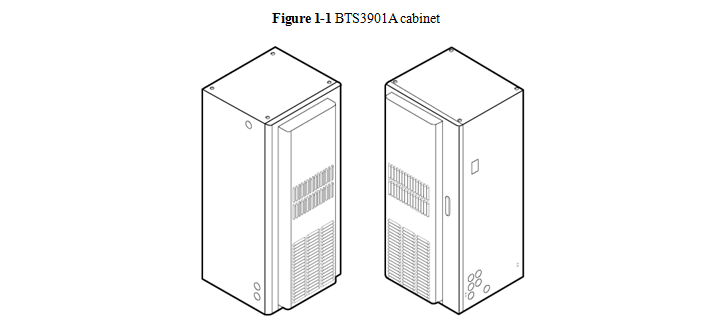
Manteniendo el concepto de innovación centrada en el cliente, Huawei lanza la estación base macro BTS3901A de exterior, una solución de red orientada al futuro que integra los recursos de la plataforma de radio y tecnologías múltiples. La BTS3901A abarca el último diseño de chips, la arquitectura del sistema, la tecnología de amplificador de potencia (PA), y la gestión de consumo de energía. Como parte de la transición de la red móvil, el lanzamiento de la BTS3901A efectivamente impulsa el desarrollo de la red móvil, presentando una red con los conceptos de "convergencia, banda ancha, ecología, y evolución'', y asiste a los operadores en la construcción de un futuro mejor orientado a las redes móviles. La BTS3901A se caracteriza por una alta integración, un bajo consumo de energía, y una rápida instalación. La Figura 1-1 muestra el gabinete de la BTS3901A.
Simple Structure, Multi-System Mergence
A BBU3900 and CDMA radio filter units (CRFUs) are installed in the BTS3901A cabinet. The BTS3901A supports different systems by sharing the same cabinet, transmission resources, network management system. In addition, the BTS3901A supports both smooth evolution from the code division multiple access (CDMA) system to the long time evolution (LTE) FDD system and convergence of CDMA and LTE FDD systems.
Outstanding Performance, Low Cost
A CRFU supports a maximum of eight carriers, with the maximum output power of 100 W. With its outstanding performance, the CRFU can provide wide coverage and high data throughput, effectively reducing the number of required sites.
The BTS3901A has high receiver sensitivity and supports remote and precise queries of voltage standing wave ratio (VSWR) values with a precision of 1.4 ± 0.2 on the M2000. This greatly reduces costs in instruments, devices, manpower, and network construction and maintenance. In addition, network construction duration greatly decreases. After deploying the BTS3901A, operators' competition edge is effectively enhanced.
With the development of data services, Huawei launches the CBSS7.0 solution to meet the increasing requirements of subscribers for high-speed data services.
- Huawei CBSS7.0 supports EV-DO Rev. B by upgrading software of channel processing boards.
- The download rate and upload rate on three carriers reaches 14.7 Mbit/s and 5.4 Mbit/s respectively with the technology of binding multiple EV-DO Rev. B carriers.
In this way, Huawei CBSS7.0 supports a higher peak rate and throughput, and is reversely compatible with the existing EV-DO Rev. A versions. Therefore, it is the best choice for CDMA operators in future.
Green Base Station, Low Power Consumption and Energy Saving
The BTS3901A greatly increases the PA efficiency by more than 40% and decreases the power consumption of the entire base transceiver station (BTS) system by employing the advanced Digital Pre-Distortion (DPD) and Doherty techniques on radio frequency (RF) units.
This greatly reduces the CAPEX in power consumption, power equipment, backup batteries, air conditioners, and heat exchangers.
Future-Oriented, Smooth Evolution
The BTS3901A, built on a unified platform, supports co-cabinet and co-mode applications of modules in different wireless systems. It meets the requirement for evolution to the wireless network, and helps operators fast deploy new radio sites.
Both RF units and the BBU3900 support CDMA and LTE FDD systems. This ensures smooth evolution and paves the way for future-oriented network investment.
Reliable Clock Synchronization
The BTS3901A receives clock signals from various clock sources such as using the GPS/GLONASS satellite card, RGPS clock, and transmission clock based on IEEE 1588 V2.
Notes for clock synchronization modes supported by the BTS3901A:
- GPS/GLONASS satellite card: The BTS3901A provides a port for clock signal input.
- RGPS clock: The BTS3901A provides an RGPS port for receiving clock signals.
- Transmission clock based on IEEE 1588 V2: The BTS3901A in FE networking mode receives clock signals after the IPCLK link is configured and the required clock source is set.
Flexible Networking Mode
BTS networking modes refer to networking modes between the BTS and the Base Station Controller (BSC). BTS networking modes include the star networking mode, chain networking mode, and tree networking mode.
1. Star networking
As the most commonly used networking mode, the star networking mode is applicable to densely populated areas. Figure 1-2 shows the star networking mode.

Advantages:
- BTSs are directly connected to the BSC, simplifying networking and facilitating engineering, maintenance, and capacity expansion.
- Data is directly transmitted between the BTSs and the BSC, improving link reliability.
Disadvantages:
Compared with the other networking modes, the star networking mode requires more transmission resources.
2. Chain networking
The chain networking mode is applicable to sparsely populated strip areas, for example, areas along highways and railways.
Figure 1-3 shows the chain networking mode.

Advantages:
Costs in transmission resources, network construction, and transmission link lease are reduced.
Disadvantages:
- Data is transmitted through a large number of nodes, causing poor link reliability.
- Faults in upper-level BTSs may affect operating of lower-level BTSs.
- The number of cascading levels cannot exceed three.
3. Tree networking
The tree networking mode is applicable to areas where network structures, site distribution, and subscriber distribution are complicated, for example, areas where subscribers are widely distributed and hotspots gather.
Figure 1-4 shows the tree networking mode.

Tree networking mode
Advantages:
Costs in transmission resources, network construction, and transmission link lease are reduced.
Disadvantages:
- Data is transmitted through a large number of nodes, causing poor line reliability, and construction and maintenance difficulties.
- Faults in upper-level BTSs may affect operating of lower-level BTSs.
- Capacity expansion is difficult because it may require extensive network reconstruction.
- The number of tree levels cannot exceed three.
| Item | Specification | |||||||
|---|---|---|---|---|---|---|---|---|
| Working band | Band Class | RX Band Range | TX Band Range | |||||
| Band Class 0 (800 MHz) | 824 MHz to 849 MHz | 869 MHz to 894 MHz | ||||||
| Band Class 1 (1900 MHz) | 1850 MHz to 1910 MHz | 1930 MHz to 1990 MHz | ||||||
| Band Class 6 (2 GHz) | 1920 MHz to 1980 MHz | 2110 MHz to 2170 MHz | ||||||
| Band Class 14 (US PCS 1.9 GHz) | 1850 MHz to 1915 MHz | 1930 MHz to 1995 MHz | ||||||
| Band Class 15 (AWS) | 1710 MHz to 1755 MHz | 2110 MHz to 2155 MHz | ||||||
| Supported carrier | A CRFU supports a maximum of eight carriers. | |||||||
| TX and RX | Band Class | RX Sensitivity (dBm) | TX Power | |||||
| Band Class 0 (800 MHz) | -130 dBm | 100 W | ||||||
| Band Class 1 (1900 MHz) | -127 dBm | 80 W | ||||||
| Band Class 6 (2 GHz) | -127 dBm | 80 W | ||||||
| Band Class 14 (US PCS 1.9 GHz) | -127 dBm | 80 W | ||||||
| Band Class 15 (AWS) | -127 dBm | 80 W | ||||||
| Transmission port | Maximum Configuration | Description | ||||||
| CMPT (4E1) and two UTRPs | A maximum of 20 E1/T1 links and one FE optical port | |||||||
| CMPT (8E1) and two UTRPs | A maximum of 24 E1/T1 links | |||||||
 The CMPT (8E1) does not support the ATM or FE transmission mode. | ||||||||
| External clock source | GPS/GLONASS, RGPS, and transmission clock based on IEEE 1588 V2 | |||||||
| Dimensions (H x Wx D) | 1725 mm x 762.5 mm x 800 mm (67.91 in. x 30.02 in. x 31.5 in.) | |||||||
| Weight | Fully-configured cabinet: ≤ 393 kg (778.37 lb) | |||||||
| Input power | 120 V AC dual-live wire: 90 V AC/180 V AC to 135 V AC to 270 V AC 120 V 3-phase star-shaped: 105 V AC/176V AC to 150 V AC/260V AC 240 V AC 3-phase triangle-shaped: 90 V AC/180 V AC to 135 V AC to 270 V AC | |||||||
Choose a proper power input mode based on the configuration of the power distribution unit for the cabinet. | ||||||||
| Power consumption | Configuration | Band Class | Input Voltage | Maximum Power Consumption | Average Power Consumption | |||
| S(1/1/1) | 800 MHz | 220 V AC | 655 W | 432 W | ||||
| S(2/2/2) | 800 MHz | 220 V AC | 795 W | 519 W | ||||
| S(3/3/3) | 800 MHz | 220 V AC | 994 W | 658 W | ||||
| S(4/4/4) | 800 MHz | 220 V AC | 1153 W | 764 W | ||||
| S(4/4/4) | 1900 MHz | 220 V AC | 1636 W | 1141 W | ||||
| S(4/4/4) | AWS | 110 V AC | 1205 W | 788 W | ||||
The power consumption above is measured when the BTS is in typical configuration. The power consumption of transmission equipment and battery charging is not measured. The maximum power consumption of a BTS varies according to working bands and configurations. | ||||||||
| Temperature | When solar radiation is not considered: -40°C to +52°C (-40°F to +125.6°F) | |||||||
| Relative humidity | 5% RH to 100% RH | |||||||
| Absolute humidity | 1 g/m3 to 30 g/m3 | |||||||
| Atmospheric pressure | 70 kPa to 106 kPa | |||||||
| Protection level | IP55 | |||||||
| Storage environment | Storage standards specified by NEBS GR 63 | |||||||
| Transportation environment | Transportation standards specified by NEBS GR 63 The cabinet can be transported with boards, which meets Huawei standard DKBA 4030. | |||||||
| Anti-seismic performance | GR-63 Zone-4 | |||||||
| Electromagnetic compatibility | FCC part 15, GR-1089 | |||||||
Reliability Specifications
| Item | Specification |
|---|---|
| Availability | ≥ 99.999% |
| Mean time between failures (MTBF) | ≥ 10,0000 hours |
| Mean time to repair (MTTR) | ≤ 1 hour |
Surge Protection Specifications
| Item | Specification |
|---|---|
| Surge protection for AC input (In/Imax) | 25kA/60 kA, 8/20 µs |
| E1/T1signal port (with the SLPU) | Differential mode: ±3 kA, 8/20 us wave Common mode: ±5 kA, 8/20 us wave |
| FE signal port (with the SLPU) | Differential mode: ±1 kA, 8/20 us wave Common mode: ±2kA, 8/20 us wave |
| Antenna port (including the GPS port) | Differential mode: ±8 kA, 8/20 us wave Common mode: ±40 kA, 8/20 us wave |