Figure 1-1 shows the position of the BTS in the CDMA2000 network.

BTS: base transceiver station BSC: base station controller
CS Domain: circuit switched domain PS Domain: packet switched domain
|
|
|
|
|
Quick Network Construction
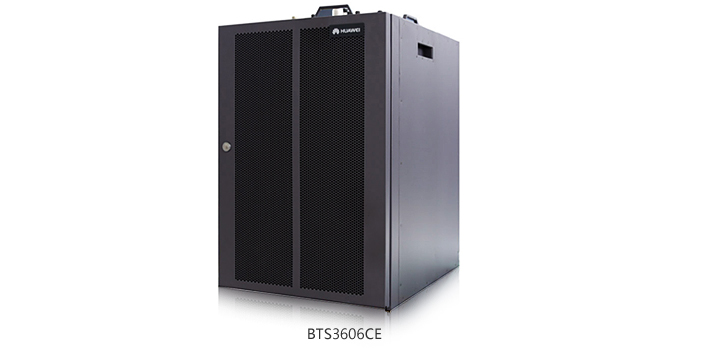
- The BTS3606CE is an indoor macro BTS with a small footprint of 600 mm x 480 mm (23.62 in. x 18.90 in.).
- The main modules and internal cables are pre-installed. Therefore, the BTS3606CE can be transported as a whole.
- The BTS3606CE can be easily installed. At the site, you need only to fix the cabinet and connect external cables.
- The BTS3606CE is a highly integrated product with a small size and light weight, and therefore easy to be transported and installed.
It meets various requirements for quick network construction.
CAPEX Reduction
- The BTS3606CE supports a maximum of 80 W cabinet-top output power per sector and a maximum of 20 W output power per sector.
- The BTS3606CE supports three cascading levels of ODUs or RRUs through optical fibers that are connected to the SFP ports of the channel boards.
- With the development of data services, to meet the increasing requirements of users for high-speed data services, the Huawei CBSS7.0 supports Evolution-Data Optimized (EV-DO) Rev. B through the channel board upgrade or software upgrade, and reaches 14.7 Mbit/s download rate and 5.4 Mbit/s upload rate on three carriers through EV-DO Rev. B multi-carrier bundling. Therefore, Huawei CBSS7.0 can reach a higher peak rate and throughput and be reversely compatible with the existing EV-DO Rev. A. Therefore, it is the best choice for CDMA operators in future.
Its outstanding performance ensures wide coverage, high data throughput, and reduction of number of sites.
OM Expenditure Reduction
- Cables are routed in the front of the cabinet, facilitating the maintenance of the BTS3606CE.
- The BTS3606CE cabinet integrates radio platform resources, having high integrity. The cabinet is light, making it easy to be transported and installed.
- The baseband module of the BTS3606CE has the same form as that of the SingleBTS, reducing the number of spare components and OPEX.
Smooth Evolution to the Future-Oriented Radio Network
The baseband unit of the BTS3606CE uses a unified platform, supports co-cabinet application of the modules in different wireless modes, meets the requirement for evolution to the radio network, and helps operators easily deploy new wireless technologies.
- The baseband supports the CDMA + LTE FDD mode, that is, the CDMA and LTE FDD share the BBU3900.
- The radio frequency (RF) module of the BTS3606CE supports the CDMA + LTE FDD mode through ODU cascading.
Therefore, smooth evolution can be guaranteed, and future-oriented network investment can be realized.
Constructing an Energy-Saving Communications Network
- Compact size, modular design, and innovative power amplification and consumption management help reduce resource occupation, such as site area and energy. The RF module uses the DPD and Doherty technologies. The power amplification efficiency exceeds 40%, and the power consumption of the whole system is reduced.
- The reduction of power consumption brings less power supply cost and less CAPEX for auxiliary devices, such as power supply, backup batteries, air-conditioners, and heat exchanger.
The technical specifications of the BTS3606CE are listed in Table 5-1.
| Item
|
Specification
|
| Working frequency bands
|
Frequency band
|
Receiving band
|
Transmitting band
|
| Band class 0 (800 MHz)
|
824 MHz to 849 MHz
|
869 MHz to 894 MHz
|
| Band class 5 (450 MHz)
|
450 MHz to 460 MHz
|
460 MHz to 470 MHz
|
| Max. number of carriers supported by one cabinet
|
4
|
| Transmitter and receiver specifications
|
Frequency band
|
Receiver sensitivity
|
Transmit power
|
| Band class 0 (800 MHz)
|
–130 dBm
|
80 W (in four-carrier working mode)
|
| Band class 5 (450 MHz)
|
–127 dBm
|
60 W (in three-carrier working mode)
|
| Power consumption
|
Frequency band
|
Configuration
|
Max. power consumption
|
Average power consumption
|
| 800 MHz
|
S (1/1/1)
|
429W
|
365W
|
| S(2/2/2)
|
628W
|
517W
|
| S(3/3/3)
|
881W
|
681W
|
| S(4/4/4)
|
1087W
|
845W
|
NOTE
The power consumption of the extended RF cabinet, transmission equipment and heater, and the charging power consumption of batteries are not included.
The power consumption provided in the preceding table is measured when the system uses –48 V DC power supply.
The power consumption of BTSs varies with bands and configurations.
|
| Cabinet dimensions (height x width x depth)
|
Single cabinet: 700 mm x 480 mm x 600 mm (27.56 in. x 18.90 in. x 23.62 in.)
Combined cabinet: 700 mm x 260 mm x 600 mm (27.56 in. x 10.24 in. x 23.62 in.)
|
| Cabinet weight
|
A fully configured cabinet weighs not more than 75 kg (165.34 lb).
A fully configured combined cabinet weighs not more than 105 kg (231.53 lb).
An empty cabinet (including the FAN and PDB, and excluding the extended RF cabinet) weighs not more than 33 kg (72.75 lb).
|
| Power input
|
–48 V DC
Voltage range: –57 V DC to –38.4 V DC
Diameter of the power cable: 16 mm2 (0.025 in2)
+24 V DC
Voltage range: +21.6 V DC to +29 V DC
Diameter of the power cable: 25 mm2 (0.039 in2)
|
| Ambient temperature for running
|
–10°C to +55°C (14°F to 131°F)
|
| Relative humidity for running
|
5% RH to 95% RH
|
| Noise in the shelter
|
Not more than 65 dBA (varying according to the ambient temperature)
|
| Air pressure
|
70 kPa to 106 kPa
|
| Wind speed
|
Not more than 30 m/s
|
| Availability
|
Not less than 99.999%
|
| Mean time between failures (MTBF)
|
Not less than 100,000 hours
|
| Mean time to repair (MTTR)
|
Not more than one hour
|
| Safety specifications
|
The BTS complies with the following safety standards:
GB4943-2000: Safety of information technology equipment.
IEC60950: Safety of information technology equipment including electrical business equipment.
IEC60215: Safety requirement for radio transmitting equipment.
73/23/EEC Low Voltage Directive.
UL 1950: Safety of information technology equipment including electrical business equipment.
IEC60529: Classification of degrees of protection provided by enclosure. (IP Code).
|
| EMC performance
|
The BTS meets the requirements for electromagnetic compatibility and complies with the following standards:
R & TTE Directive 1999/5/EC
R & TTE Directive 89/336/EEC
ETSI EN 301489-1/26
ETSI EN 301908-1/5
ITU-R SM.329-10
The BTS passes the European standard certification.
|